
17. Arc Of Descent.
The Spider Creek Club, November 1945

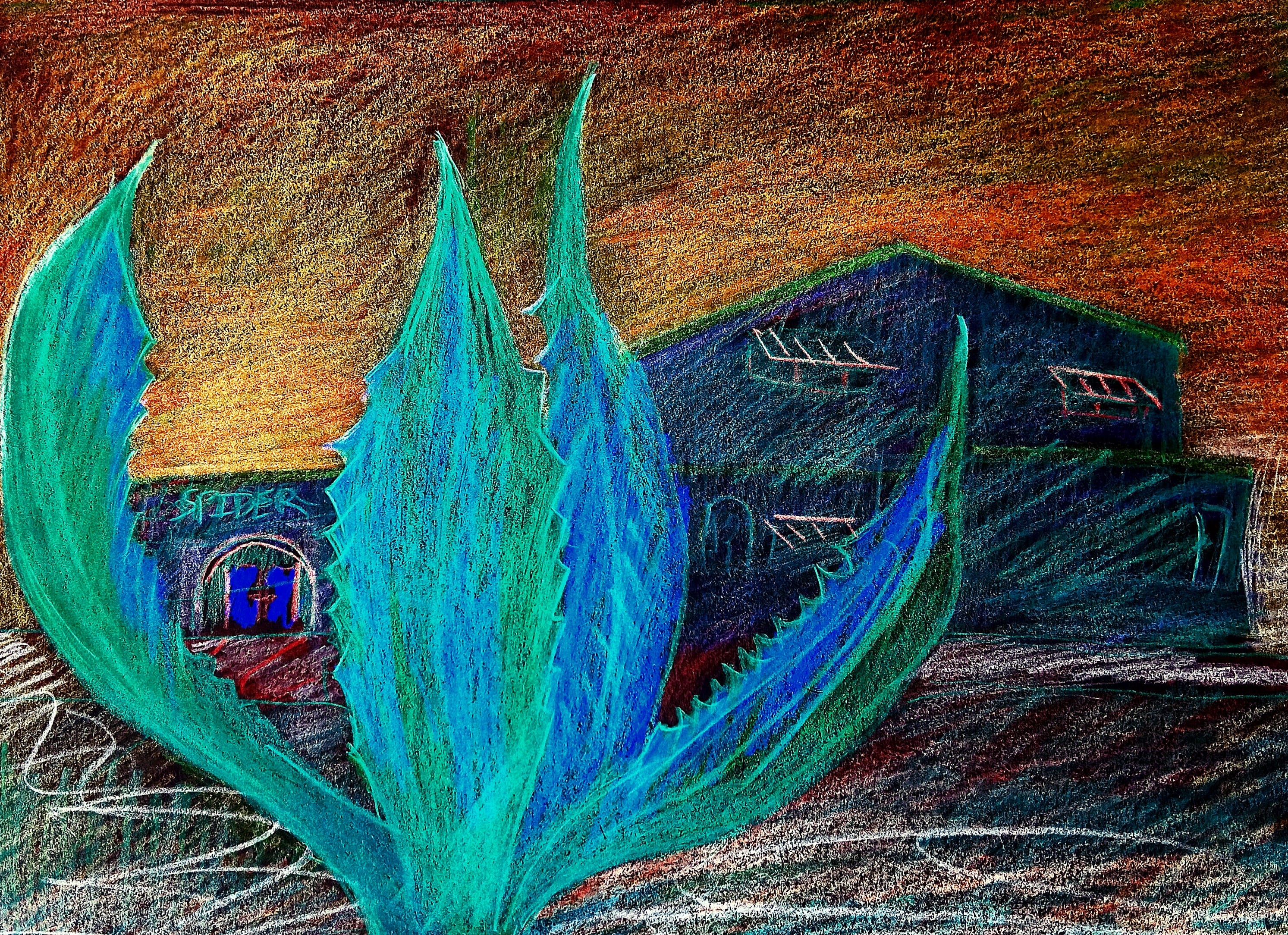
Two nights later Iris and Art drive north on Sepulveda Boulevard in her 1936 Chevrolet, a workhorse slow as a mule heading into the hills, ten-thirty by the time she parks on the wide dark street, streetcar tracks glinting in the lamplight.
Art steps out of the vehicle, a soldier in his composure and a soldier in his gallantry, strides around to the driver’s door, opens it, hands her out and guides her sleekly — to where? No one around, no people, no cars, a wide empty street running straight on into darkness. The buildings along each side are low and dark, then further up he sees a spill of light, people going up a walkway, fine people laughing.
Iris tugs him to the lighted door, and the elegant man inside says, “Welcome back, Miss Iris.”
“Thank you, André,” she says, and then Bowden hurries over, exclaims “Art, my dear, returned to us safe courtesy of the army!”
“Say, this is your place?”
“It is, dear one. Let me show you to our best table,” and he leads them through to a hidden corner with an excellent view of the stage.
André remains at his desk, observes Bowden fawn over this man and his girl, and directs a waiter to take extra care of these two, and should Archie put in an appearance (unlikely) steer him well away.
Bow slips back to him. “Where’s Cady?”
“Sleeping it off in Apple Valley, I’m sure.”
“Thank God. And Russ?”
“Livng it up in Hollywood, honey.”
“André, let’s make sure our soldier has a pleasant time here.”
“Special?”
“Very.”
“Mmm hmm,” André keeps his council. Somehow you work for a guy for two years and still you never know who he is.
Bowden is now a youthful middle-aged man of the Southern California type, tan and trim and well turned out. He has kept his shape, grown into the contours of his face, cheekbones sketched by grey at the temples, voice modulated to a burnished growl. André is not yet thirty, his refinement throwing a fleeting beauty, and though Archie, Bow and Cady might have their names on the lease, the license, and every permit City Hall demands, the Dry Spider is André’s dominion, for he books the bands, buys the jukebox discs, and has charge of the seating around the dancefloor.
The waiter places Manhattans on the table and Art reaches for his wallet. “Oh no soldier, it’s all taken care of, drinks and anything you might care for from the menu. Caviar’s off I’m afraid, but we do have an excellent Coho salmon roe.”
Art lights himself a Lucky, one for Iris. “We’ll have another couple of drinks. You hungry honey?”
She holds her cigarette just so, hand bent back at the wrist, that little purse of the lips as she swans her neck, blows the smoke up to the red walls and ebony moldings of their alcove. Art aspires with his cigarette, no foot soldiers’ perfunctory puff. The fact is, he has smoked more in the last three days than in all the eighteen months he was traipsing around Europe chasing Nazis. He knows it is a defensive gesture — drink, smoke, laugh, pretend it never happened — but it did happen, he was there.
He savors the comforting twist of smoke through his throat, looks to the stage as the lights dim and the musicians walk on in darkness. The drummer sits behind his drums, the bass player twirls the instrument into his hands, a young woman sits at the piano. A tap-tap on the cymbals, a sigh repeated on the bass, and a slow trill as the trio slip easy into How High The Moon.
The moon is up stairs rising steep, dark water of the bay behind them, ships as shadows rippled in the air . . . he smoked a Lucky walking back, asking himself what he’d done and what it meant.
He downs his drink and a full glass appears on the table, the waiter’s arm a movement at the edge of sight. His head snaps around, his heart pounds, and then the piano runs a boogie-woogie to his ears, rhythm skipping tones, smoke hanging in the air, and he is back in the club, Iris bouncing her knee beside him.
That knee goes wild and Art’s knee hops and the piano slips and slides, their hands everyone hands clap-clap and Iris is on her feet, out of the booth and around the table and he’s up there next to her damn it don’t matter the joint is jumping and this band is striding into tomorrow.
A final crash of chords, a reverberation of tinkling notes, and the young woman says soft into the microphone, “We’ll be back to play The Zodiac Suite after a short break.”
Art is happy. Iris in his arms and they kiss deep and long, hidden in the shadows until a figure appears at the table.
“Gilbert!” She jumps up, opens her arms to a pale washed-out man in a baggy blue suit with wide lapels, icy blue eyes flickering in the lamplight.
“Isis my word!“ he crows with delight. “And don’t tell me, this must be Arthur. Such a pleasure to meet ya.”
“Won’t you join us?” Art waves an arm that encompasses the world.
Gilbert places a small glass of gin on the table and sits behind it. This is soon downed and replaced with a much larger glass.
“To your safe return,” he raises this glass to Arthur. “Was it so very bad over there.”
“Bad, no, no, that’s not the word for it, I don’t have the word, don’t know what it is.”
“Try saying it in French.”
“Shut up Gil,” Iris, her face a glow.
“See how she is!”
“Salût Gil.”
Iris has not looked this happy since Art got back. She loves this little man, she’s infatuated. Art sees the way they look at each other, and a part of him slides into happiness too, like an iceberg calving.
“I do salute you sir,” Gil says with great sincerity, “I was requested to sit it out, the lungs consequential from perpetual rain and fog.”
“Gilbert found me the job at the exchange,” Iris clasps his hand and swings it and Gilbert kicks up his foot, throws back his head and tra-la-las at the ceiling.
“You work there too?”
“At one time. I have since departed for greener pastures.”
“A succession of pastures,” Iris laughs. “We were at Boeing together, right around the time you enlisted.”
“Miss Iris stood out from the herd.”
Gene Krupa strikes up from the jukebox. Art rises, bows without satire, “if you’ll excuse me for a minute,” and heads off to the men’s room.
Iris watches him wend between the tables. His clothes don’t fit right, the jacket loose in the waist and narrow in the shoulders . . . but it’s not that, it’s how he carries himself, an indefinable searching slouch. She sees a waiter point him up a couple of steps to a corridor that curves out of sight.
“Where was he wounded?” Gilbert asks.
“Far as I know he wasn’t.”
*******************
There are two guys at the urinal, silent, staring up, watched by a sad attendant in a red jacket with gold cuff buttons. All the cubicles are unoccupied. Art takes the last one, closes the door, hangs his jacket and drops his pants, sits down in the submarine dark, the steady drip of the plumbing, tries to calm his breathing. He hears them out there finishing up, the zip and rustle, water running, and then all the tension seems to leave him.
So what if Iris’s little friend can see him for what he is, Iris won’t believe him. How do these guys do it — just give you one look and know? Sum you right up there and then: he’s ready to be had.
He pisses. Another guy comes in. Art rattles the toilet paper, make it sound like he’s doing more, waits for him to leave then flushes and goes out. The attendant turns on a tap, says “Alright soldier,” and hands him a towel. Art puts a quarter on a little silver dish by the sink, adds a dime for the ‘soldier.’ Hell, he’s drinking for free tonight.
He rounds the curve of the wall into the club, peers through the dim lights and smoke, finds their table and makes his way over, Iris bent close to Gilbert, a beam of recognition alighting on her face.
“We’re lost in the shadows here,” he says.
“Everything copacetic Artie, only you look like you seen a ghost,” Gilbert says.
“Guess I’m haunted for a while yet.” Art gulps his drink, feels the bourbon tingle down to his fingertips.
“Don’t fret so, you just got back.” Iris threads an arm around him, the way she used to back at school, those warm fall evenings when the athletes were out on the field.
He kisses her cheek, then her brow, then pecks kisses to her ear and down her neck, makes her eyelids flutter.
“Well look at the lovebirds,” Gilbert says.
The Andrews Sisters swing out from the jukebox and Iris rocks backs against the banquette. “Isn’t it magical!”
“Like night-time in Naples,” Art says, and immediately bites his tongue. She either doesn’t hear or doesn’t understand, but Gilbert hears. His look across the table brngs the color to Art’s face, and Art mimes blowing a bugle in time to the song, which only makes it worse. Gilbert raises his eyebrows. Everything makes it worse. He knocks back the coctail, and then somehow Iris is in his arms again, cheek to his shoulder as they float across the dance floor slow and sultry, Lena Horne singing Love.
Grand to be home dancing in a magical cave of twinkling lights and red walls. Iris stumbles on his foot, says, “Your Papa thinks I’m a lush, worries I’ll lead you into perdition.”
“I don’t care what he thinks.”
“He might have a point.”
“I didn’t go half way around the world getting shot at just to have him tell me how to live.”
“Don’t worry. he won’t tell you anything, he’s scared of you. I seen it.”
“Papa ain’t scared of anyone, let alone me.”
“Believe it Art. He’s got it in his head you killed people. He’s scared.”
“I was a soldier, what does he think, I went over there for the raviol?” His grip tightens on her shoulder.
“Lord knows what he thought. He collected every goddamn newspaper he could, piles of them in the garage, but I don’t think he read one page. Rita followed it every day, where you might be, the battles, everything — but Papa, no, no, his heart broke the day you enlisted.”
“And yours?”
“I couldn’t have been prouder.”
*****************
Back at the booth a man has joined Gilbert, both of them embarking on a fresh round of drinks. This apparently is Sam. Iris has heard of him. She takes out a cigarette and the precocious young man is prompt with a lighter. Gilbert beams.
“Can I take him home with me,” Iris says.
“If you can feed him, he’s yours!”
“Don’t listen to him,” Sam laughs, “I’m a wonderful cook.”
Art watches this exchange and a tilt of seasickness washes through him, a sudden roar in his ears. He perches heavy at the edge of the booth, steadies himself against the table. No one notices. He drinks fast and the roar pops.
“You were in Italy?” Sam asks. He has green eyes, at least in this light. In bed they might be nearer blue.
“Yep, Anzio. Then France, Germany, the whole tour — except Greece. We were lucky, we skipped Greece.”
“I wouldn’t think you were one for skipping Greek.”
“Damn it Gil!”
“It’s all right Iris, I can take car of him.” Art stands, leans on the table, then shoots a hand out and grabs Gil’s tie. Iris gasps.
“Listen buddy, while you were playing happy families with your pal here . . .”
A pair of arms circle Art, pull him back, and Archie purrs into his ear, “Arthur dear, you’re scaring the horses. Now come have a dram with me at the bar.”
**************
Out in the night air he’s suddenly clear-headed, drives because she’s had more to drink than she can manage, and she can manage a lot. He likes to drive high, though he prefers a snappy little roadster, not this wagon, no feel for the road.
“Sorry we didn’t get to see more of Mary Lou Williams.”
“Maybe it’s for the best,” and she turns on the radio. The bass slaps sharp and the piano has the devil on the keys, the horn comes in rich and slow, taking its own good time, and Art know he is haunted. He is nineteen, and the voice inside keeps insisting, this is me.
“What did Archie say to you?”
“Just told me to go home before I made a damn fool of myself.”
“Next left,” she says.
“Where we headed?”
“Western and Melrose.”
“That where you live?”
“I do,” she says.
“Damn, I thought you lived down the street, you’re at the house every day.”
“I’m driving in babe, just for you,” and she puts her hand over his on the gearstick. The car swerves across a lane and he whoops as a horn honks.
It’s a new atomic world.